Category: Uncategorized

  • When ‘Cultural Fit’ Becomes a Weapon

    When ‘Cultural Fit’ Becomes a Weapon

    Ever felt like you had to shrink yourself just to fit in at work?


    Not because you weren’t capable.
    But because the culture was exclusive by design.
    Where who gets invited, heard, promoted—or even welcomed—follows an unspoken rulebook.
    And the worst part?
    It’s not just about one toxic leader or outdated policy.


    🛑 It’s the system that lets them stay.
    🛑 The one that rewards silence, protects sameness, and labels any challenge as “not a cultural fit.”


    We tell people:
    🗣️ “Speak up.”
    🗣️ “Raise concerns.”
    🗣️ “Be authentic.”


    But when you do?
    You’re left out of meetings you used to be in. Passed over for promotions. Called “difficult.” Or “too much.” And then we wonder why people disengage. Why they leave. Why they burn out.
    Exclusive work cultures don’t survive by accident.
    They’re held up by the quiet complicity of systems that know what’s going on—but choose convenience over courage.


    ✨ It’s not enough to write values on the wall.
    ✨ It’s not enough to post rainbow flags once a year.
    ✨ It’s not enough to hire “diverse talent” if you’re going to erase their voices once they walk in the door.


    Work shouldn’t require you to abandon who you are. Or pretend not to notice what everyone sees. So if you’ve ever sat in a meeting and thought, “This isn’t right”… you’re not imagining it.
    If you’ve had to tone yourself down just to feel safe


    That’s not culture. That’s control. We deserve more. More honesty. More equity. More spaces where people don’t have to fit in to belong.


    Let’s build that. Or at least start by naming what’s broken.
  • The strenght of leading women

    The strenght of leading women

    Leading women aren’t always on magazine covers.
    When women have women in their corner, there are no limits.
    Behind every Leading Woman is often a quiet but fierce network—mentors, peers, friends—lifting her up, pushing her forward, and reminding her she belongs in every room where decisions are made.


    The phrase “Leading Women” holds more weight than it seems.
    It’s not just a book, a consulting firm, an award, or an organization.
    It’s a movement.
    It’s a mindset.


    And more importantly, it’s a mirror.
    A mirror to the women who came before us—👑 Hatshepsut, Eleanor Roosevelt.
    To the women we see today—🌍 Angela Merkel, Kamala Harris, Sheryl Sandberg, Malala.
    To the women we grew up with—our mothers, sisters, teachers, neighbors.
    To us.


    Because leading women aren’t some far-off icons.
    They’re everywhere—in history, politics, business, art, community.
    They challenge gender roles.
    They redefine leadership.
    And they leave the ladder down for others.
    When women support women, it’s not just a nice idea.
    It’s a force.
    We don’t just break ceilings. We build new rooms.
    We don’t wait for space. We create movements.

    So I’ll ask again:
    🌱 Are you that woman?
    🌱 Do you know that woman?
    🌱 How do you use your voice, your power, your influence?
    Role modeling isn’t a buzzword. It’s how we start a ripple.
    And that ripple? It becomes legacy.


    Here’s to leading women—and the ones who lead with and for others.

  • Equality v Diversity

    Equality v Diversity

    Gender equality and diversity get mentioned together so often that people sometimes forget… they’re not the same thing.

    Equality is about fairness.
    Diversity is about difference.

    Equality says: “No matter who you are, you should have the same opportunities.”
    Diversity says: “Who you are matters — and we want you to bring all of that to the table.”

    One is about action. The other is about recognition.
    And we need both.

    👩‍💼 Gender equality means equal pay for equal work. Equal access to promotions, funding, leadership.
    👥 Diversity means building teams with different ages, backgrounds, religions, sexual orientations, and ways of thinking — not to tick boxes, but to build better systems, ask better questions, and make better decisions.


    And here’s the truth:
    You can have diversity without equality. (Think: a team that looks colorful on a poster, but behind the scenes, only one voice is really heard.)
    You can have equality efforts without real diversity. (Policies on paper, but no shift in culture.)

    ⚡ But when the two meet — when people feel safe and valued, supported and seen — that’s when the magic happens.

    So no, it’s not just about “hiring more women” or celebrating Pride Month.
    It’s about asking:
    ➡ Are we creating a culture where everyone can thrive?
    ➡ Are we willing to be uncomfortable in order to grow?
    ➡ Are we making sure every seat at the table isn’t just filled, but heard?

    Let’s stop blurring the line between diversity and equality.
    And start designing workplaces — and societies — that know how to do both.

    What’s one small shift you’ve seen (or made) that helped move the needle forward?

  • What are homogenous teams?

    What are homogenous teams?

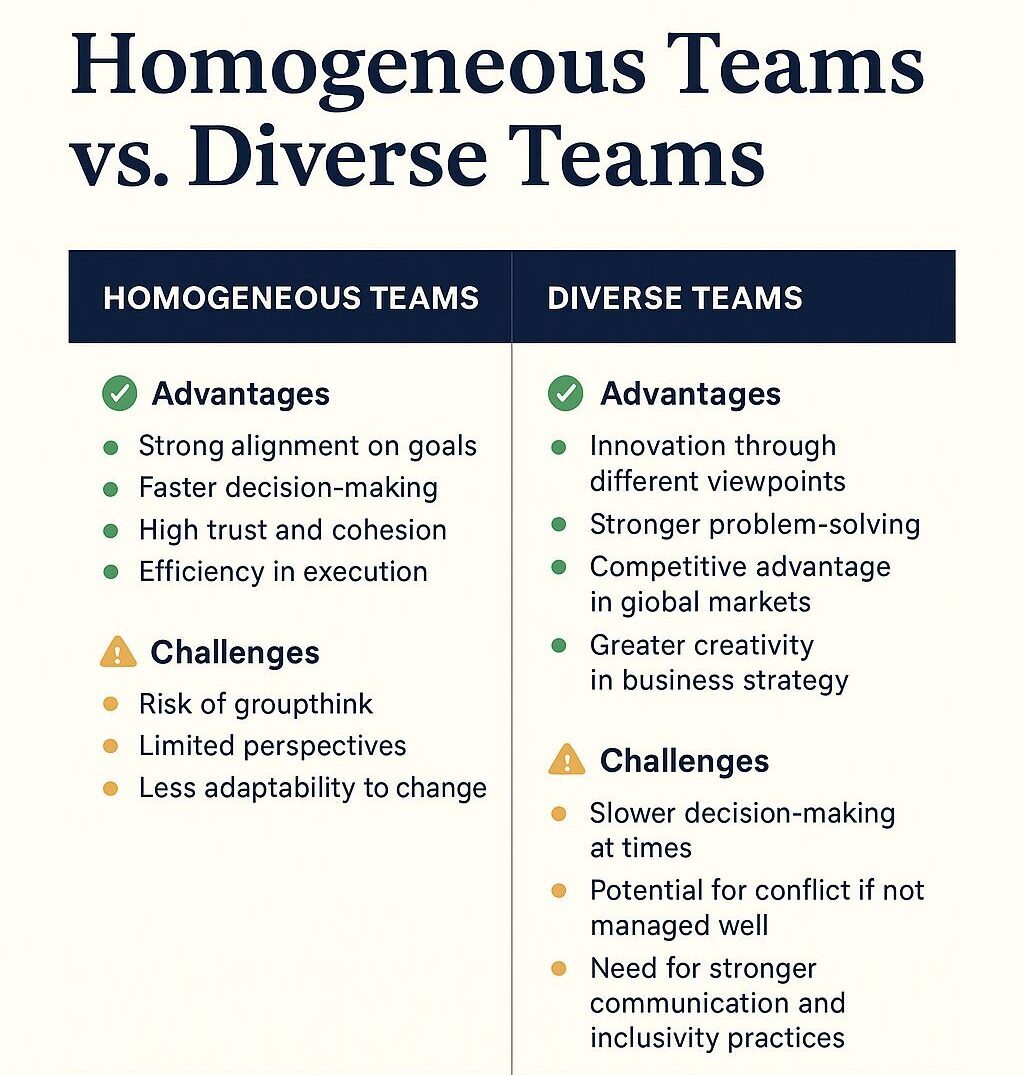
    Homogenous teams are like a mirror. Everyone reflects the same ideas, values, and ways of thinking. It feels comfortable, quick, efficient. No friction, no major disagreements. Work gets done.

    But here’s the catch. Comfort rarely creates breakthroughs.

    💡 Diverse teams are more like a kaleidoscope. Different backgrounds, experiences, and ways of thinking mix together. It’s not always smooth. Sometimes, it’s even messy. Discussions take longer, decisions require more listening, and egos need to step aside.

    And yet… this is where real innovation happens.
    This is where blind spots get challenged.
    This is where solutions emerge that no single perspective could ever create.

    Yes, homogenous teams often feel easier. But easy doesn’t always mean better.
    Diverse teams push us further. They force us to explain, to re-think, to open up. They stretch us beyond what’s comfortable – and into what’s possible.


    The strongest organizations know how to harness both: the efficiency of alignment and the creativity of difference.

    So maybe the real question isn’t:
    ➡ Do we want homogenous or diverse teams?
    But rather:
    ➡ How do we create cultures where differences aren’t just tolerated, but truly valued?

    Because when diversity isn’t just a box to check but a force we embrace, teams don’t just grow. They transform.
    What’s your experience – have you thrived more in the mirror or in the kaleidoscope? 🌍

  • The “Right Time”

    The “Right Time”

    When Is the “Right Time” to Start a Business?

    We grow up imagining that big decisions come with a sign from the universe, a sudden moment of clarity, a green light, an absence of fear. But anyone who has built something meaningful will tell you that the opposite is true.

    If you’ve ever felt the spark to start a business, an idea that keeps tugging at your mind, a vision you can’t shake, there’s a good chance you’ve also felt the doubt.

    We often wait for the perfect moment, when we have more experience, more funding, or more time.
    But here’s the truth: there’s never really a perfect time to start.

    So When Is the Right Time?

    It’s when the idea won’t leave you alone.
    It’s when your heart whispers “what if?” louder than your fear says “what if not?”
    It’s when you realize that waiting another year won’t make you more ready—just more frustrated.

    The right time is now – not because everything is lined up, but because you are capable.

    Every founder you admire once started from uncertainty. They didn’t have all the answers, they just took the first step and learned as they went.

    At Diverse Founders Network Denmark, we believe in progress over perfection.
    Entrepreneurship is a journey, one where you grow, adapt, and discover your strength along the way.

    ✨ So ask yourself:
    Are you ready to become your own Boss?

    Because the time isn’t perfect — but you are ready.
    And you’ll learn as you go.